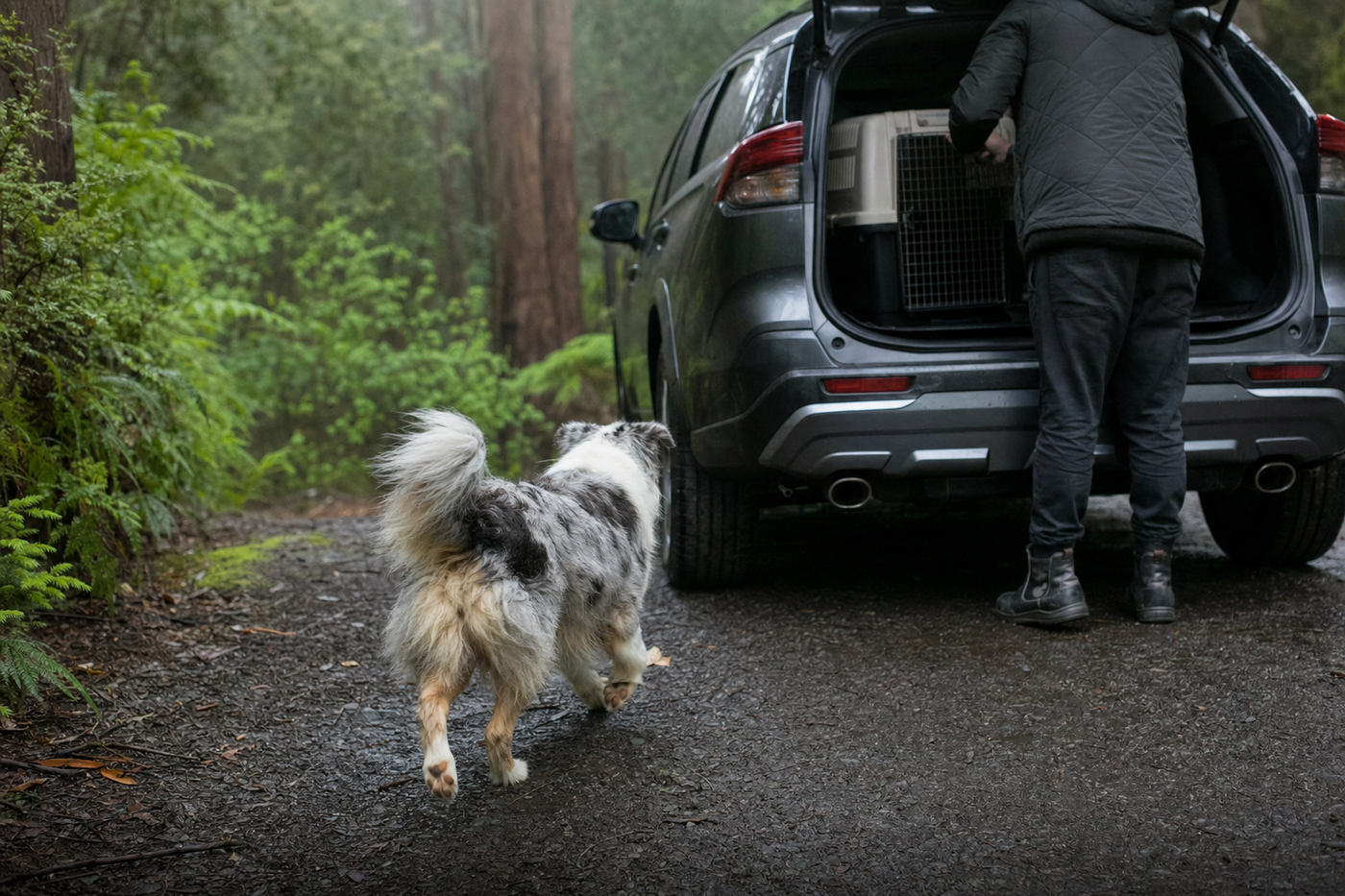
Heat stress in dogs can occur within 15 minutes on hot days. Never leave a dog unattended in a parked vehicle and always ensure multiple ventilation sources during driving.
Unsecured crates can cause injury to your dog and passengers during sudden braking or accidents. Always secure crates with straps or tie-downs before driving.
Why Your Dog Needs a Travel Crate in the Car
I learned the hard way that a loose dog in a car is a liability for everyone. My kelpie mix once jumped into the front seat during a drive from Sydney to the Blue Mountains and caused me to swerve into the next lane. A proper travel crate keeps your dog safe, protects your passengers, and reduces distractions while you focus on the road.
Australian roads vary wildly in conditions and traffic. You might be cruising the Pacific Highway or navigating bumpy outback tracks to reach a remote holiday destination. A secured dog won't become a projectile during sharp turns, sudden braking, or rough terrain. Your dog also travels with less anxiety when confined to a familiar space rather than bouncing around a moving vehicle.
Many Australian insurance companies now require dogs to be properly restrained during travel. A crate that's installed correctly gives you peace of mind at every checkpoint and tourist stop along the way. Your vet will also confirm that crate training makes emergency vet visits less traumatic for anxious dogs.
Gear we would pack
Some links below are affiliate links. Pawtrips may earn a commission at no extra cost to you.
Dog travel crate for Australian cars
Browse multiple hard-sided and soft-sided crate options designed for Australian vehicles of all sizes. Find models that fit your specific boot space and match your dog's breed and travel needs.
Hard-Sided Crates: Durability for Long-Distance Trips
Hard-sided crates built from plastic or reinforced materials are your best bet for serious Australian road trips. These crates can handle the punishment of pot-holed roads between Melbourne and Adelaide or rough tracks leading to national parks. They're typically heavier than soft-sided alternatives, but that weight means stability and protection if you need to brake suddenly.
The downside is that hard-sided crates take up considerable boot space. My Ford Territory has plenty of room, but I know plenty of people with smaller hatchbacks who struggle to fit one in. You'll need to measure your vehicle's boot width, depth, and height before ordering. Most large hard-sided crates measure around 91 centimetres long by 61 centimetres wide, which works in medium to large SUVs but becomes tight in compact cars.
Hard-sided crates offer excellent ventilation through built-in vents on multiple sides, which is crucial on hot Australian summer days. They're also the easiest to clean after muddy beach trips or dusty outback adventures. The plastic construction resists chewing and scratching better than mesh alternatives, so you won't watch your investment deteriorate over multiple trips.
Soft-Sided Crates: Flexibility for Smaller Vehicles
If you drive a compact car, hatchback, or sedan, a soft-sided crate might be your solution. These fabric and mesh crates fold down almost flat when not in use, making storage at home practical. I've seen soft-sided crates squeezed into the back seats of Toyota Corollas and Hyundai i30s, which wouldn't be possible with rigid alternatives.
Soft-sided crates are lighter and easier to manoeuvre into position, especially if you're packing up camp in a carpark and need to move things quickly. They cost less upfront than quality hard-sided options, so you can afford better comfort features like padded flooring. The trade-off is durability, particularly if your dog is a serious chewer or you frequently travel on rough roads where the crate gets jostled constantly.
Ventilation in soft-sided crates relies on mesh panels, which work well in mild weather but might not provide enough airflow during Australian summer heatwaves. These crates are also harder to clean thoroughly if your dog has an accident during a long drive. You'll want to invest in machine-washable crate mats that you can remove and clean separately. If you travel mainly on sealed roads within cities and towns, a soft-sided crate offers reasonable security without eating half your boot space.
Soft sided dog crate
Explore collapsible soft-sided crate options perfect for compact cars and vehicles with limited boot space. These crates fold down when not in use and work well for dogs that don't chew heavily.
Size Considerations for Different Breeds
Getting the size right matters more than most dog owners realise. Your dog should be able to stand up, turn around, and lie down comfortably, but not have excessive room to slide around during turns. A crate that's too large defeats the purpose of containment and makes your dog feel less secure during travel.
Small breeds under 15 kilograms fit into crates starting at around 60 centimetres long, which most hatchbacks can accommodate. Medium breeds like border collies and cattle dogs typically need 75 to 90 centimetre crates. Large breeds like labradors and golden retrievers need the full 90 to 107 centimetre range, which requires a proper SUV or wagon. I measured my 28-kilogram labrador mix at five different pet shops in Brisbane before finding a crate where she could stand without hunching her shoulders.
Consider your dog's growth if you're buying a crate for a young pup destined to become a large adult. You don't want to buy three different crates over the next five years. Conversely, don't buy an oversized crate hoping your dog will grow into it. An oversized crate encourages dogs to use one corner as a toilet area and sleep in another, which teaches bad habits you'll regret on week-long trips across Australia.
Installation and Securing Your Crate Safely
A crate that slides around your boot during cornering is almost as dangerous as having no crate at all. I once watched a crate shift during a left turn near the MCG in Melbourne, and my dog yelped in panic. Now I use a combination of straps, tie-downs, and sometimes cargo nets to lock everything in place before driving anywhere.
Most quality crates come with tie-down points on the corners. Use these with adjustable cargo straps available at automotive stores or hardware shops like Bunnings. Tighten straps firmly so the crate doesn't shift, but not so tight that you can't remove the crate when needed. Some vehicles have built-in anchor points designed for this purpose, so check your car's manual before assuming you'll need to drill or bolt anything.
If your crate sits on the rear seats rather than in the boot, use a seatbelt to secure it through the crate's frame. Never rely on wedging the crate against the back seat alone. Test your installation by pushing the crate firmly from multiple angles before your first long drive. Your dog's safety depends on secure installation, not just hope.
Temperature Control and Ventilation on Australian Roads
Australian summers are brutal, and a poorly ventilated crate becomes an oven within minutes. Your dog can suffer heat stress in as little as 15 minutes on a 35-degree day. I always ensure my crate has vents on at least three sides and position it where direct sunlight won't hit during the middle of the day. On trips from Perth to Broome in summer, I've used sunshades and reflective covers specifically designed for dog crates.
Airflow matters more than the type of crate material. Hard-sided crates with vents on multiple sides stay cooler than you'd expect because air circulates through. Soft-sided crates with mesh panels allow breezes to flow through but offer less protection if the sun beats down directly. Use your car's air conditioning while driving, and never leave your dog in a parked car, not even with windows partially down.
Consider crate placement within your vehicle. A crate in the middle of the boot stays cooler than one positioned against a side window. If you're driving long distances between towns in remote areas, time your driving to avoid peak heat hours between 11 am and 3 pm. Stop every two hours for breaks, water, and toilet opportunities. Your dog's comfort during travel determines whether they associate car trips with stress or adventure.
Dog crate mat washable
Add comfort to your dog's travel crate with machine-washable mats that fit most standard crate sizes. These mats absorb moisture from accidents and provide essential padding for long journeys.
Comfort Features That Make Long Drives Tolerable
A bare plastic crate floor becomes uncomfortable on trips lasting more than a couple of hours. Invest in a quality washable dog crate mat that fits your crate dimensions. These mats provide padding, absorb moisture if accidents happen, and can be removed and washed after muddy adventures at coastal towns or national parks. I've used the same mat across multiple crates over the years.
Some dogs benefit from having a familiar toy or blanket inside their crate to reduce travel anxiety. A durable rubber toy keeps your dog occupied during stops when you're not driving, but avoid toys with small parts that could become choking hazards if your dog gets stressed. Rope toys that shed fibres are problematic in confined spaces. A stuffed Kong toy works brilliantly on long drives and gives your dog something to focus on besides the motion and noise of the vehicle.
Water access is important on long drives, but you don't want a full water bowl sloshing around in the crate. Use a spill-proof bowl clipped to the crate door, or remove water during the drive and offer it during breaks at rest stops. Many dogs stop drinking during car journeys anyway due to motion sensitivity, which is another reason to stop every two hours.
KONG Wild Knots Tiger Toy for Medium/Large Dogs
Keep your dog occupied during long drives and rest stops with a durable rubber toy designed to withstand chewing. This toy provides mental stimulation and reduces anxiety during car travel.
Testing Your Setup Before Major Trips
Before committing to a week-long drive from Brisbane to Cairns, take your dog on short local trips to build familiarity and confidence. Start with 15-minute drives to a nearby park, then gradually extend to one-hour drives to different suburbs. Your dog learns that the crate means car travel, and the motion becomes predictable rather than frightening.
Use these test runs to identify problems with your setup. Does the crate shift when you brake? Does your dog panic when the crate door closes? Does condensation build up inside on humid days? These issues are fixable on short trips but become nightmares during a long journey across the outback. I discovered my dog gets carsick after 90 minutes of driving, so now I plan routes with more frequent stops.
Observe your dog's behaviour in the crate during test drives. Some dogs settle quickly, while others take weeks to become comfortable. Never force your dog into a crate or use it as punishment. Instead, make the crate a positive space where your dog voluntarily enters for treats and naps. The investment in this preparation pays dividends when you're halfway through a long trip and your dog remains calm and secure.
Plus early access to new guides and partner deals.
No spam. Ever. Just the good stuff for you and your pet.