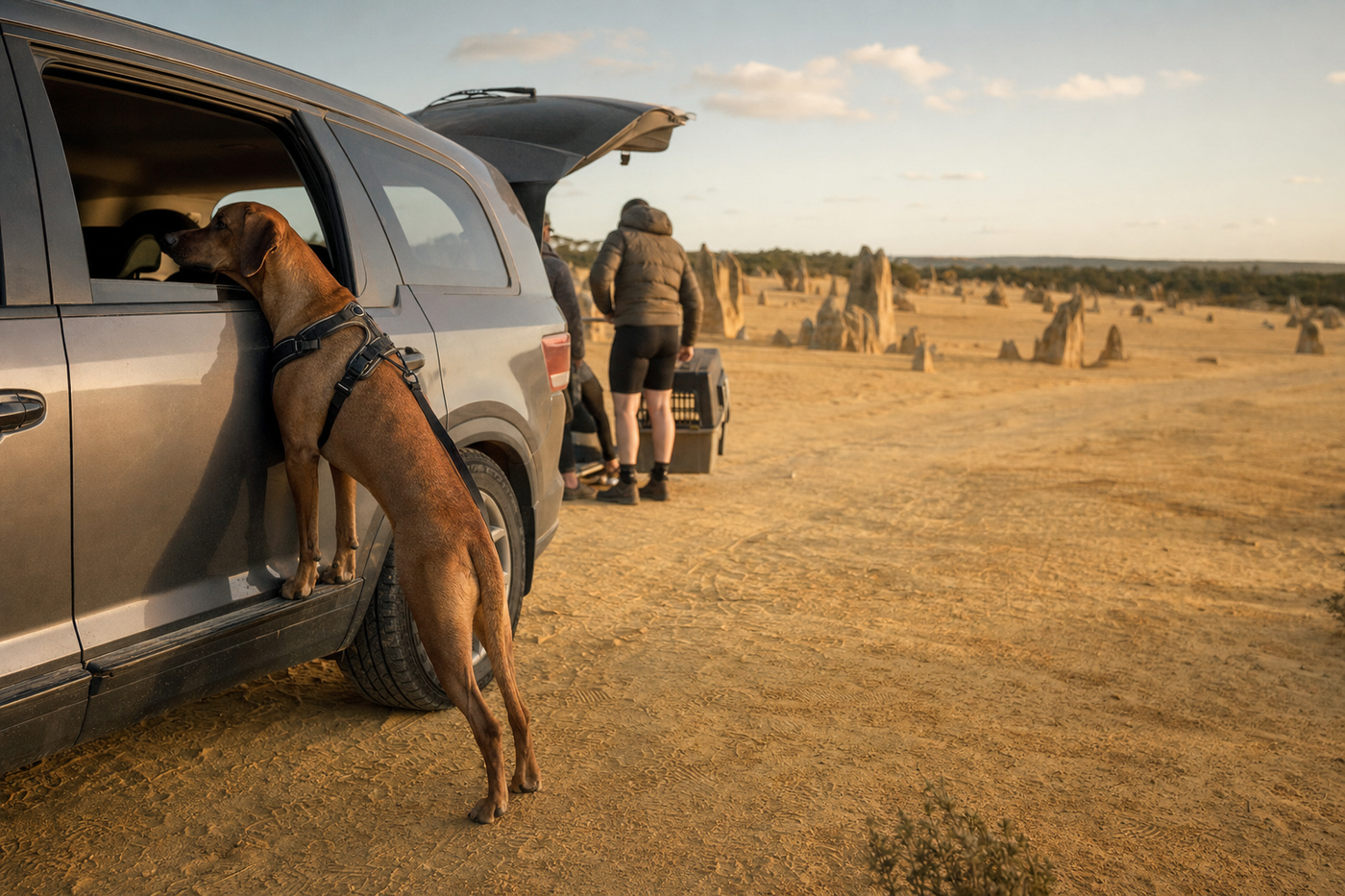
Crated dogs can suffer heat stroke within 15 to 20 minutes in parked vehicles on hot Australian days, even with windows partially open. Never leave a crated dog unattended in a vehicle.
Poorly fitted harnesses can restrict breathing or cause injury during sudden stops. Always ensure proper fit before long journeys and choose harnesses designed specifically for vehicle travel rather than walking harnesses.
Why restraint systems matter on Australian roads
I learned the hard way that an unrestrained dog becomes a projectile in a sudden stop. During a trip from Melbourne to Geelong, I braked hard for a kangaroo, and my kelpie flew forward into the front seats. That split second taught me that restraint systems are not about control, they are about survival.
Australian roads present unique challenges. Long stretches between towns mean you might drive for hours without a service station. Single-lane highways in regional areas see head-on collisions happen regularly. A loose dog inside the car makes emergency stops worse because it can distract you, obstruct your vision, or injure itself and everyone in the vehicle.
Veterinary research shows that dogs not restrained in cars suffer more severe injuries in crashes than those that are secured. The RSPCA in Australia recommends restraint systems as a legal and ethical requirement for pet safety. Understanding the differences between harnesses and crates helps you choose the option that actually protects your dog during the thousands of kilometres you might drive together.
How car harnesses work and their real advantages
A car harness connects to your dog's body using straps that loop around the chest and back legs, then anchor to the vehicle's seatbelt system or boot tie-down points. The best harnesses distribute force across multiple contact points so your dog absorbs crash impact more safely than if thrown against the vehicle. I switched to a harness after that kangaroo incident, and my dog sits calmly on the back seat now during our trips to the Adelaide Hills.
Harnesses offer practical advantages for Australian travel. They take up minimal space, which matters when you are already squeezing luggage for a week-long road trip. Your dog can see out windows and feel less isolated, which reduces anxiety on long stretches of the Princes Highway or other major routes. You can stop quickly at rest areas without moving the harness, then get your dog out for bathroom breaks and movement.
Temperature management is better with harnesses because air circulation around your dog is unrestricted. In Western Australia, where you might drive through 40 degree heat between Perth and Albany, keeping your dog cool matters. Most quality harnesses cost between 80 to 150 dollars, making them affordable for most dog owners. Look for harnesses with crash test ratings, which indicate they have been tested for effectiveness in actual vehicle collisions.
Gear we would pack
Some links below are affiliate links. Pawtrips may earn a commission at no extra cost to you.

Gentle Chew Toy for Teething Puppies
A calming chew toy is great for easing travel stress in puppies.

Internal Knotted Dog Toy for Less Mess
Durable design means less mess when travelling with your pet.

Quiet Cordless Dog Clippers for Stress-Free Grooming
Quiet grooming tools reduce stress, perfect for on-the-go grooming.

Portable Dog Ramp for Safe Car Access
This ramp helps pets safely access vehicles during travel.
Understanding crates for car travel and when they work best
A crate creates an enclosed space where your dog travels in familiar surroundings. If your dog has grown up in a crate at home, a travel crate in the boot can feel like a safe den. Some dogs genuinely prefer this setup because it reduces visual stimulation and creates a quiet zone away from activity. I have friends with nervous dogs who swear by crates because the dog settles faster on car journeys.
Crates work best for small to medium dogs on shorter trips of two to three hours or less. If you are driving from Sydney to the Blue Mountains or Brisbane to the Gold Coast, a crate keeps your dog secure and contained. The downside appears on longer journeys. A dog in a crate cannot move around, stretch its legs, or shift position, which causes discomfort and increases anxiety. On a six-hour drive from Melbourne to Adelaide, a crated dog experiences genuine physical stress.
Space and temperature are practical concerns with crates. A large dog crate takes up most of your boot, leaving minimal room for luggage, water containers, and travel gear. Crates also limit air circulation, which becomes dangerous in Australian heat. Even with ventilation holes, temperatures inside a crate rise faster than in the open air. Crates also make emergency stops harder because you cannot quickly access your dog to check on them or help them out if needed.
Crash safety ratings and what the research shows
Not all harnesses are equal. The ones that matter for serious protection are those that have undergone crash testing similar to human seatbelts. Some brands like Kurgo and Ruffwear have published crash test data showing their harnesses significantly reduce injury compared to unrestrained dogs. These tests use weighted dummies to simulate dogs of different sizes being subjected to realistic collision forces. If a harness does not have published safety data behind it, treat it as a restraint for convenience rather than protection.
Crates offer different protection. A solid crate can absorb some impact and prevent your dog from being thrown forward, but the dog inside still experiences sudden deceleration forces. A 30 kilogram dog in a crate suddenly braked from 100 kilometres per hour still experiences enormous force concentrated in a small space. The crate itself might survive intact while the dog inside suffers internal injuries from the sudden stop.
Research from veterinary associations suggests that properly fitted harnesses that distribute force across the body offer better outcomes than crates in most crash scenarios. A harness spreads the stopping force across the chest, shoulders, and hips. A crate concentrates force on whatever part of the dog hits the crate walls first. For genuine safety on Australian roads, choose a harness with crash test ratings over an untested crate or harness.
Temperature and comfort on long Australian drives
Australia gets hot, and dogs cannot cool themselves like humans do. During a road trip from Perth towards Esperance in summer, I realised how quickly a crate heats up even with the windows down and air conditioning running. The moment the car engine shuts off at a rest stop, a crate becomes an oven. Your dog trapped inside cannot escape the heat, cannot pant efficiently, and risks heat stroke within minutes on a 35 degree day.
Harnesses let your dog benefit from air conditioning flowing through the entire car. Your dog can shift position, lie down across the back seat, or sit up to catch breezes from windows. The difference on a cross-country drive is significant. A dog in a harness experiences gradual temperature changes as you move in and out of air-conditioned spaces, while a crated dog experiences sudden temperature shocks.
Comfort during long drives affects dog behaviour. A harness allows your dog to change position every few minutes, reducing muscle stiffness and joint stress. A crate forces your dog into one position for hours, which causes discomfort and anxiety. Dogs in crates often become stressed and restless, leading to excessive barking, panting, and panic. Dogs in harnesses on back seats tend to settle down, sleep, and arrive at your destination calmer and less exhausted.
Practical considerations for different Australian destinations
Your choice between harness and crate depends partly on where you are travelling. For urban trips where you stay in pet-friendly hotels and take multiple short drives around Brisbane or Melbourne, a crate might work if your dog is comfortable in one. You can set up the crate in your hotel room, and your dog has familiar sleeping quarters. For road trips spanning multiple days with long driving stretches, a harness becomes more practical.
The Great Ocean Road, a popular drive with many pet owners, involves six to eight hours of continuous driving. A harness allows your dog to travel comfortably while remaining secure. If you plan to visit multiple towns, stop frequently, and explore parks along the way, a harness gives you flexibility. You can pull over quickly and let your dog out without moving crate hardware. A crate adds setup and takedown time at each stop.
Consider your dog's age and health too. Senior dogs with arthritis struggle in crates because staying still for hours increases stiffness. A harness lets an older dog shift weight and adjust position. Young puppies have too much energy for crates on long drives. A harness on a back seat with someone to supervise is safer than a crated puppy that panics. Match your restraint choice to your specific dog's needs and your typical journey length rather than assuming one approach suits all situations.
Making the final choice for your dog and your trips
If you drive regularly and frequently cover distances over three hours, a quality harness with crash test ratings is the better investment. Brands that publish safety data and fit most dog sizes cost between 80 to 200 dollars and last for years. A good harness works for multiple dogs if you replace the straps as needed. You can use the same harness for daily car trips to the vet as well as long road trips.
If your dog is small, you only take occasional short drives, and your dog already loves its crate at home, a travel crate might work for your situation. Ensure the crate is ventilated, secure it properly so it cannot slide during stops, and never leave your dog in the crate while the car is parked without running air conditioning. This option works for specific circumstances rather than as a general solution.
The safest approach for most Australian dog owners involves a crash-tested harness for regular travel. Test it with short trips before committing to long journeys so both you and your dog feel confident. Watch your dog's behaviour during these test drives. If your dog seems anxious or uncomfortable, try adjusting the harness fit or positioning. Most dogs adapt quickly to harnesses and show reduced stress on car journeys once they realise the harness means safety and adventure ahead.
Checking Australian regulations and insurance implications
Australian animal welfare laws require dogs to be adequately restrained in vehicles, but the laws vary by state. New South Wales and Victoria have specific regulations about dog restraint, while other states have less defined standards. The key legal requirement across all states is that your dog cannot distract the driver or be at risk of injury. A harness or crate that meets this requirement protects you legally as well as practically.
Insurance implications are worth considering. If your dog causes an accident because it was unrestrained and distracted you, your car insurance might refuse to cover the claim. Some pet insurance policies also have clauses about safe travel practices. Using a crash-tested harness or properly secured crate demonstrates you followed reasonable care standards, which supports insurance claims if an accident occurs.
Contact your state's transport authority or local council to confirm specific regulations for your area. The RSPCA in Australia provides guidance on safe dog travel that aligns with both legal requirements and best practices. When you purchase a harness or crate, keep the receipt and any safety documentation. This paperwork helps if you ever need to prove you took appropriate safety measures. Combining legal compliance with genuine safety practices means you can travel with confidence.
Plus early access to new guides and partner deals.
No spam. Ever. Just the good stuff for you and your pet.