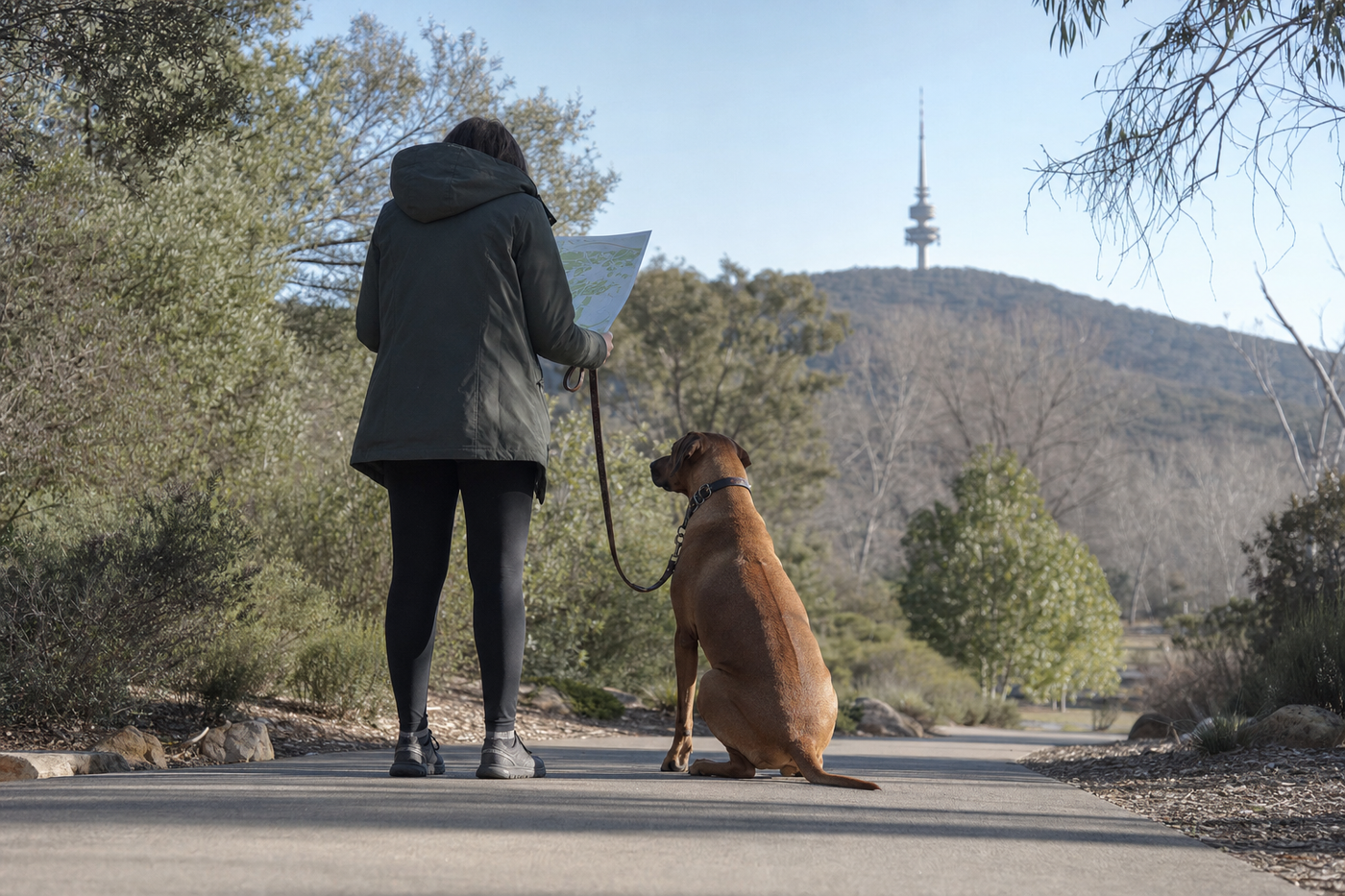
Fines for non-compliance with ACT dog laws start at 100 dollars and escalate quickly for repeated offences or serious violations like owning a restricted breed without approval.
If your dog escapes and roams unsupervised in the ACT, you can be fined and your dog may be seized by rangers and held in an impound facility until claimed.
ACT Dog Registration: Your First Step
You cannot travel with your dog to the ACT without understanding registration requirements. The ACT requires all dog owners to register their dogs within 12 months of acquiring them. Registration costs around 45 dollars for a standard dog and must happen through the ACT Gambling and Racing Commission or your local council office.
When I first drove from Sydney to Canberra with my border collie, I thought registration was optional for temporary visits. It is not. Rangers patrol parks and suburbs throughout Canberra, and I learned this lesson when a ranger stopped me at Haig Park and asked to see my registration papers. Your dog needs to be registered in the ACT or you need documentation proving current registration in another state. Keep your registration certificate with you when travelling. Without it, you face fines starting at 100 dollars and can be prevented from accessing public spaces where your dog might enjoy exercise.
Lead Requirements and Off-Leash Areas
The ACT has strict rules about when your dog can roam free. All dogs must be on a lead of maximum 1.8 metres in public spaces unless they are in a designated off-leash area. These off-leash parks exist throughout Canberra, including popular spots like Watson Off-Leash Area near Lake Burley Griffin and the Dickson Off-Leash Area near the shops.
When travelling with your dog, you need a compliant lead before you arrive. Many visitors buy leads that are too long or use retractable leads longer than 1.8 metres, and rangers will approach you to correct this. Your lead should be sturdy and measured beforehand. The ACT considers off-leash areas safe spaces where your dog can socialise with other dogs, but you remain responsible for your dog's behaviour. Even in off-leash areas, aggressive or uncontrolled dogs can be removed by rangers. Plan which parks have off-leash areas before you visit so your dog gets proper exercise.
What we recommend
Some links below are affiliate links. Pawtrips may earn a commission at no extra cost to you.
Dog lead 1.8m compliant
The ACT requires leads to be maximum 1.8 metres in public spaces, and a quality compliant lead made from leather or sturdy nylon keeps your dog secure and legal. This prevents rangers from stopping you and ensures your dog cannot roam beyond safe limits.
Microchipping and Identification Laws
Microchipping is not optional in the ACT, and it is non-negotiable for travelling dogs. Every dog must be microchipped and the microchip must be registered with the ACT Animal Register. If your dog is not yet microchipped, you must do this before entering the ACT or immediately upon arrival. The procedure takes minutes and costs between 30 and 50 dollars at most veterinary clinics.
Your dog also needs visible ID, preferably a collar with your contact number. I learned the hard way when my kelpie slipped her collar at a cafe in Civic and a local resident found her three hours later. Because she had a microchip and engraved ID tag, the vet reunited us within an hour. The ACT takes identification seriously because it reduces the number of dogs in shelters. When you travel, carry proof of microchipping and ensure your emergency contact number is current. If you move between states, update your microchip details immediately with the ACT register.
Dog microchip and ID tag
Microchipping and visible ID are legal requirements in the ACT and essential for reuniting with your dog if lost. Having both a microchip registered with the ACT register and an engraved ID tag with your phone number ensures local residents and vets can identify your dog quickly.
Dangerous Dog Breeds and Restrictions
The ACT has a restricted breed list that you must understand if your dog falls into these categories. Restricted breeds include American pit bull terriers, perro de presa canarios, Japanese tosas, and dogo argentinos. If you own one of these breeds, you cannot simply travel to Canberra without preparing in advance.
Restricted breed owners need specific approval from the ACT Gambling and Racing Commission before entering the territory. You must register your dog as restricted, which costs around 150 dollars annually. Your dog must be microchipped, wear a muzzle in public spaces, and be kept in a securely fenced yard. The muzzle cannot be homemade and must allow your dog to drink and pant. I know a staffy owner who drove from Brisbane to Canberra and was stopped by rangers within her first hour because she did not have the required muzzle. She had to drive to a pet store immediately and then file for restricted dog status. Check the full ACT list before travel because breed restrictions can be strict and fines for non-compliance reach 300 dollars or more.
Dog muzzle for breed-specific legislation areas
If your dog is a restricted breed, an ACT-compliant muzzle is legally required in public spaces and must be comfortable and properly fitted. A quality muzzle allows your dog to drink and pant while meeting legal requirements.
Fencing Requirements for Pet-Friendly Stays
If you are booking a pet-friendly accommodation property in Canberra, your dog must be contained by a minimum 1.2 metre fence. Many holiday rentals and pet-friendly accommodations have fences, but older properties sometimes have lower fences or gaps. Before you book or arrive, ask the accommodation owner specifically about fence height and condition.
When I rented a cottage in Tuggeranong, the fence was only 1 metre high and my kelpie jumped it on the first day. The rental agreement stated the fence was pet-safe, but it was not adequate for an active dog. Now I message accommodation owners with photos of fence sections and ask them to confirm the height. Some properties allow you to pay extra for supervised yard time or have enclosed courtyards that work better. The ACT Council can fine you if your dog escapes and roams the neighbourhood, so do not assume the fence is adequate based on the listing alone. Measure it or ask for specific measurements before you book.
Pet-friendly stays compliant with local laws
Booking through platforms that verify ACT fencing requirements and pet policies saves you from arriving at accommodation that does not meet legal standards. This ensures your dog stays safely contained and you remain compliant with local regulations.
Council Areas and Regional Variations
The ACT is divided into four council areas: Canberra City, Gungahlin, South Canberra, and Weston Creek. Each area can have slightly different rules and enforcement practices. Before you travel, check the specific council area where you will be staying because dog park locations and restrictions vary.
Weston Creek, which covers suburbs like Weston and Chapman, has different off-leash area opening hours than Gungahlin areas like Belconnen. Some areas have stricter enforcement of lead laws than others. When I travelled to visit family in Wanniassa, I assumed the same rules applied throughout Canberra, but the local ranger told me that South Canberra councils had recently introduced new dog exercise area restrictions. Check the ACT Government website or contact your local council directly. You can phone the council office for the suburb where you will stay and ask about their specific dog laws. Having this conversation before you arrive saves you from fines and conflicts with rangers.
PitPat Dog GPS Tracker - No Subscription Needed
A GPS tracker provides extra security if your dog escapes or gets lost during your Canberra visit, allowing you to locate your dog quickly without relying on microchip scanner availability. This is especially valuable when travelling in unfamiliar suburbs and council areas.
Transporting Your Dog Safely to the ACT
Getting your dog to Canberra safely is different from arriving there with legal compliance. If you are driving from New South Wales, Victoria, or Queensland, your dog must be comfortable in the car and have proper ventilation. The drive from Sydney to Canberra takes around four hours, and your dog needs water stops and exercise breaks.
Many dog owners use harnesses or carriers to keep their dogs safe during transport. Never leave your dog unattended in a parked car, especially during warm months. Plan your route to include parks where your dog can walk and stretch. When I drove from Wollongong to Canberra, I stopped at Goulburn for 30 minutes to let my dogs run around a local park. I also carried collapsible water bowls and a travel blanket. If your dog gets anxious during car travel, consider starting with short drives weeks before your trip. Some dogs become stressed on long journeys, so having calming treats or a familiar toy helps. Arrive in Canberra with your dog calm and well-exercised rather than agitated from hours in the car.
Staying Compliant During Your Canberra Visit
Once you arrive in Canberra with your dog, maintaining compliance throughout your stay protects you and your dog. Keep your registration documents, microchip proof, and vaccination records accessible at all times. If you plan to visit multiple parks or take your dog to pet-friendly restaurants or shops, have your lead with you at all times.
Avoid taking your dog to beaches or nature reserves that restrict pets. Many of the national parks around Canberra, like Namadgi National Park which sits 45 kilometres south of Canberra, do not allow dogs or restrict them to certain walking trails. Before visiting any attraction, check its pet policy online or phone ahead. I learned this when I drove to Tidbinbilla Nature Reserve expecting to walk trails with my dogs only to find they were only allowed on the main road walk. Respect these restrictions because they exist to protect wildlife and other visitors. The ACT is beautiful for dog owners, but it requires you to follow rules consistently throughout your stay.
Plus early access to new guides and partner deals.
No spam. Ever. Just the good stuff for you and your pet.